
Hiking Canada’s West Coast Trail Itinerary
- Duration
- 9 Days
- Distance
- 75 km
Trip dates do sell out — please book early to get the dates you want.
The West Coast Trail is the classic coastal hiking trip, the gem of Vancouver Island hiking. Travel through breathtaking coastal temperate rainforests, on sandstone sea shelves, and through woody trail. This 75 km backpacking hike was made as a stranded mariners’ lifeline. Exploring the tide pools and hiking the beaches can make the trip unforgettable, but sighting the whales and other wildlife living in this area is the gravy on top. Throw in the history and geography and you’ve got an unforgettable nine-day hiking adventure that will stay with you for the rest of your life. The West Coast Trail is full of wonderful surprises: from the crab shack in the middle of the trek to the two Canadian Coast Guard lighthouses right off the trail, you will be fed with experiences that leave you full and happy.
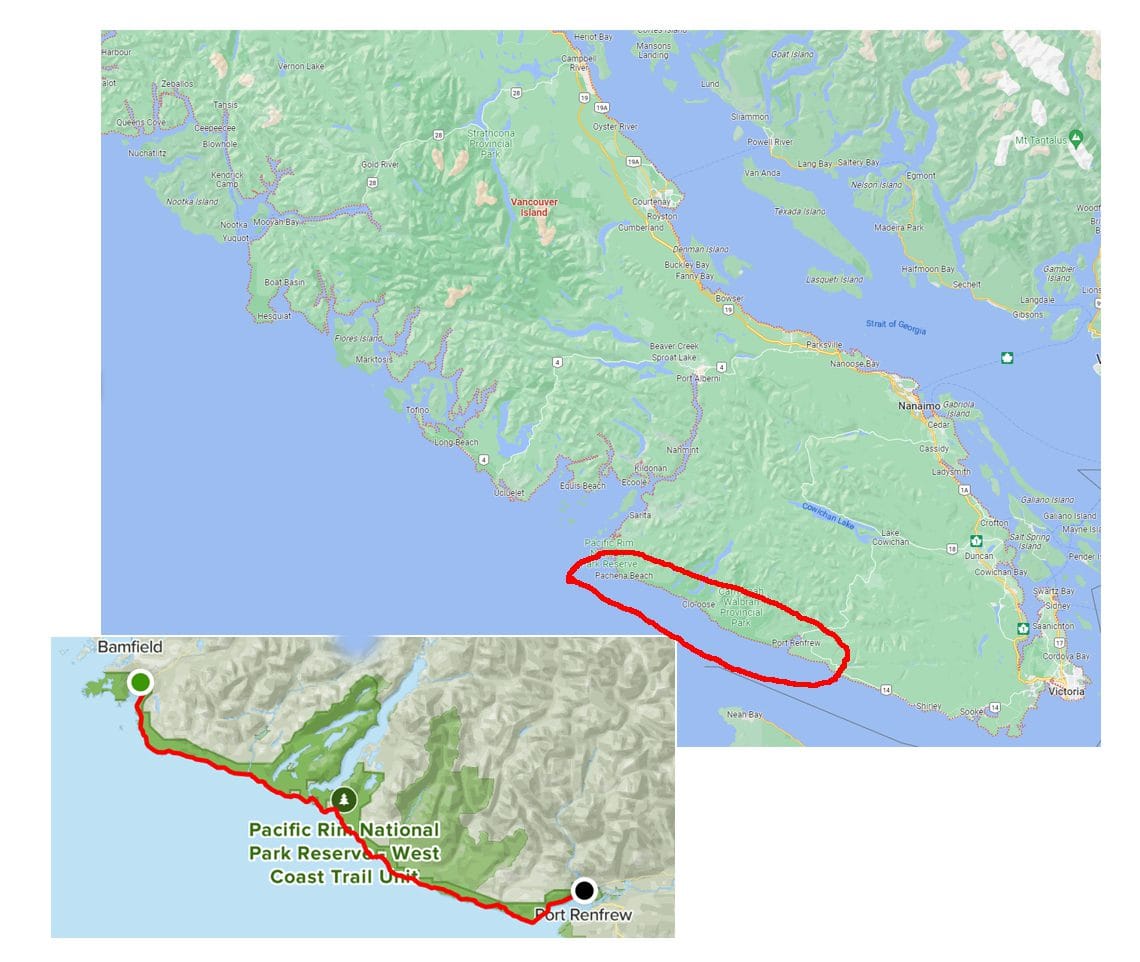
The following itinerary is our ideal, and we most often manage it; however, sometimes we need to adjust the itinerary, due to weather, tides, trail conditions, group ability, and various other factors. We plan to take you to all the amazing, best places along the trail, but your safety is paramount, and sometimes we must alter the daily itinerary.
History
The 75-kilometre (47-mile) West Coast Trail is part of the ancient paths and paddling routes used for trade and travel by first nations. Huuay-aht, Ditidaht, and Pacheedaht villages and camps were well established before the foreign sailing ships started to arrive off this coast over 200 years ago. As the years passed and the number of ships sailing the Juan de Fuca Strait increased, so too did the number of shipwrecks and drownings along the coast. In time, the coastline became known as “the Graveyard of the Pacific.” It was built in 1907 to facilitate the rescue of survivors of shipwrecks along the coast. The West Coast Trail is open from May 1 until September 30.
Subject to Changes
This is our typical itinerary for this tour. Because we are travelling in wilderness, itineraries can change. There are many factors that can affect how a tour actually runs. We confirm pickup times by phone, email or SMS at least 12 hours before.
Daily Itinerary
Day 1: Travel Day
Pick up Departure Bay 08:15-08:30; downtown Nanaimo 08:45-09:00, Duke Point 09:30-09:55 (Your guide will confirm times the day prior to tour).
We then drive to Port Renfrew (stopping in Lake Cowichan for you to buy some lunch). Set up camp and attend the WCT orientation from Pacific Rim National Park. We then do our own gear orientation, to help you ensure your pack fits well and is loaded efficiently. Following this, we go to a local restaurant in Port Renfrew for dinner (cost not included).
Day 2: Gordon River – Thrasher Cove
Rise by 6:00 pack up and enjoy breakfast, and to be ready to walk to the ferry across Port San Juan to the trailhead. The trail in this section of the hike can be some of the most challenging, with lots of roots to step over, and the highest point on the trail to be ascended and descended. Much of the day, hikers have their eyes on the trail and their feet, to avoid tripping. We stop around an old donkey engine or at the highest point on the trail for lunch. Other stops along the way to rest, make equipment adjustments and take photos. After reaching the junction between Camper Bay and Thrasher, we descend to Thrasher Cove. This section takes about 1 hour. We camp, and dine on the beach around a welcoming campfire (if permissible) and hear stories of shipwrecks. [The following day's accessibility to Owen Point may alter this itinerary day.]
Day 3: Thrasher Cove – Camper Bay
We pack up, and enjoy breakfast before beginning the day, by maneuvering over and around the boulders and pocket beaches, toward Owen Point (tide-dependent section). We stop at Owen point for photos, before traveling along the sandstone shelf, to one of the forest access points, where we stop for a well-earned lunch. After lunch, we continue through the lush, rain-forested trail to Camper Bay, where we cross the river, either by cable car or on stepping stones (if the water is low enough). We have now reached our next night's camp, where your guides will boil water for an afternoon beverage, and begin dinner preparation. There is an opportunity here for you to bathe and refresh yourself in the creek next to the camp.
Day 4: Camper Bay – Walbran Creek
We are up very early for breakfast to begin the long day to Walbran Creek. This is one of the most varied days. If the tides are right, we take a route along the sandstone at sea level, crossing a few surge channels before climbing off the shelf, and hiking up the spectacular Sandstone Creek to the inland trail (The sandstone section of the trail is little-known by other hikers, as it requires guide experience and careful tide planning). Once on the main forested trail, we begin to ascend and descend some of the longest ladder sections on the trail, the first being out of Sandstone creek, followed by the ladders at Cullite Creek, often a nice spot for lunch. After lunch, we make our way to Logan Creek and the final set of major ladders for the day. Following this, we hike along a boardwalk, through an environmentally sensitive, upland bog region. Here we marvel at Bonsai cedar trees, insect-eating Sundew plants, Labrador Tea, and many other indigenous plants. After the upland bog, we continue again through lush, rain forest to Walbran Creek, arriving late afternoon. A refreshing dip in the inviting creek pool by the camp is a welcome treat before a warm drink, a well-earned, hearty dinner, and hearing stories of shipwrecks.
Day 5: Walbran Creek – Cribs Creek
A welcome sleep-in is warranted today, the toughest part of the trail now behind us, we amble along the beach, at a more leisurely pace, exploring tide pools, and watching crabs scurry along, at the sound of our boots approaching. We round, Vancouver point, then Bonilla Point, where we get our first glimpse of the Carmanah Light station. We stop at Bonilla Point to check out the beautiful waterfall and remains of an old shipwreck. We hike past picturesque sea stacks, across Carmanah Creek, and are drawn along the final stretch of beach toward the remains of Chez Monique, now closed with little real prospect of re-opening. We usually stop here for lunch, then after lunch and a short rest, we visit Carmanah Light Station, view the sea lions, and continue for about another hour and a half, through forest and on beach to Cribs Creek. We spend the night here watching for surfing sea lions and Gray whales.
Day 6: Cribs Creek – Tsuquadra
We begin walking along the magnificent natural rock break wall from Cribs creek, with tide pools, watching again for surfing sea-lions. This is a truly incredible place! Most of the morning is along beach and shelf until we reach Cheewaht Beach, just before the Cheewaht River. Here we enter the forest and travel along boardwalk until we reach the Nitinat Narrows for a fresh crab, or fish and baked potato lunch, with the option for beer or soft drinks (this is approximately $30 per person, and not included in the trip cost, so be sure to bring some cash with you). While we are there, we pick up our food drop and distribute it out to packs. Once lunch and re-stocking is finished, we then hike on to our next beach campsite, a secret wild camping gem. There is once again an opportunity to relax before dinner, listen to amazing stories of bravery, heroism, and struggles of early settlers and First Nations. We are often treated to sightings of Gray whales feeding very close to shore at this location.
Day 7: Tsuquadra – Klanawa via Tsusiat Falls
This morning we leisurely break camp and make our way to the ancient Ditidaht Warrior Camp, where we will meet one of the Ditidaht First Nations guardians, for a short cultural interpretation on the historic significance of the area. Following this, we will make our way to “Hole-in-the-Wall”, and then on to Tsusiat Falls, where we will stop for lunch. A refreshing dip under the falls is a highlight for many hikers. We then ascend a set of ladders to continue along the cliff tops, enjoying breathtaking views from this vantage point. Later descending to Klanawa Creek, before we take the last cable car across the pond and arrive at our camp for the night, where we can often enjoy another refreshing dip.
Day 8: Klanawa Creek – Darling River, or Michigan Creek
The hiking gets progressively easier at this end of the trail. We begin along the beach and alternate between inland trail, and beach/sea shelf walking, first to Tscowis, where we stop for lunch, and if the tides are favourable a short side trip (pack free) back toward where Valencia ran aground in 1906, leading to the creation of the West Coast Trail (Shipwrecked Mariner’s Trail). Here, by a peaceful waterfall, we pause for thought for all those lost to the sea. After lunch we make our way along the beach to Darling River and Michigan Creek. We will stay at one of these beautiful beaches for our last night, savouring our experiences of our journey around the campfire, and preparing ourselves for re-entry into the busy world.
Day 9: Darling River/ Michigan Creek – Pachena Bay
Our packs are lighter, and our spirits are high as we head off after breakfast, by about 7:30. We travel the last 12 km of easy trail to the Pachena Trailhead. Oh yes! Lest you forget the trials of the trail, there is still some MUD today. We stop at Pachena light station, and the Sealion rock to watch the social antics of the massive male sea lion in his harem. The feeling of achievement is intensified as we walk the final section of the beach trail, leading to the Park office and trailhead. We congratulate one another, take photos, weigh out our packs, and check out of trail. On most tours, we will be met by our bus driver, who will have a delightful lunch, with lots of fresh vegetables, and fruits, ready for us. We make our way back to the populated world of lattes and showers. Drop-off in Nanaimo is usually between 4:30 and 6:00 pm, depending on your destination and the traffic.
What's Included
(Items that are covered in the cost of tour price)
- Transportation from the point of origin and return
- Snacks/beverages on the expedition
- All meals while on the backpacking portion**
- Meal preparation
- National Park Backcountry Camping and Permit fees
- Trail ferry fees
- Exceptional guides for the entire journey
- Cooking gear/camp stoves/water filtration
- Tents† & tarps
- Emergency radio/satellite phone/major first aid supplies
What's Not Included
(Items that are NOT covered in the cost of tour price)
- Transportation to point of origin, transfers, personal equipment, accommodation and food other than included in the itinerary.
- National Park Entry Pass (although this can be purchased for a single park, a National Parks Discovery Pass, individual or family, meets this requirement. If you already have a NP Discovery Pass, you will need to bring it and present it.)
- Gratuities are not included. Our guides make every effort to ensure your holiday is all you expected and more. Recognition of a job well done is always appreciated; $10-20/day per guide is recommended.
Good to Know
** You will be responsible for food you may want on travel days
** You will be responsible for the food you may want at the Nitinaht Crab Shack
† Solo travellers can request a Single Tent for $6.50 per day
Sleeping bags, sleeping pads, backpacks, and poles are available for rent.
All-inclusive Tour
From pickup to return, we cover everything you need, except your personal items. We take you to and from the trip start, and feed you well along the way. We can’t guarantee weight loss on our tours.
Knowledgeable Guides
Our guides get out into our areas. They know the ins and outs of the trip and provide exceptional interpretation of flora, fauna and history.
Supportive Preparation
We give you an entire packet of information on how to prepare, what to bring, how to pack, and a plan for training so you can fully enjoy the trip. Our care for you starts before you even arrive.
After the Tour
If traveling back with us on the bus, it is a journey along rough roads to civilization, through Cowichan Lake or Port Alberni. This day can be quite a rush at times as we get back to the van and ready for the drive back. Timing is sometimes an issue if participants are catching ferries to the mainland on this day. Sometimes this limits stops on the return journey.
There are other transport options available for those traveling to Tofino / Ucluelet, or wishing for a faster journey back to Victoria. These include a water taxi service to Ucluelet, and flights directly from Bamfield to Tofino, and to Victoria.
Getting There
Pickup: Nanaimo, BC
Pickup is at Departure Bay Ferry Terminal, Duke Point Ferry Terminal, downtown Nanaimo, or one of the hotels below.
Days Inn Harbour View Nanaimo
809 Island Hwy South, Nanaimo, BC1-250-754-8171Visit the website
Best Western Dorchester Hotel
70 Church, Nanaimo, BC1-250-754-6835Visit the website
Painted Turtle Guesthouse
121 Bastion Street, Nanaimo, BC1-250-753-4432 Toll-free 1-866-309-4432Visit the website
Getting to Vancouver
Many of the major North American carriers fly into Vancouver or, alternatively, Seattle. Check with your travel agent for options. There is a bus service, Quick Shuttle, from Seattle’s airport to hotels in Vancouver. These run daily and are reasonably priced. For more information, in North America, phone 1-800-665-2122 or 1-604-940-4428, and fax 1-604-940-4429. Check the link regarding shuttles and other airport information.
Getting to Nanaimo
If you are travelling into the Vancouver, Victoria, or Nanaimo area from afar, you should arrive at the departure location (in Nanaimo) for your trip the day/evening prior to the trip start date and plan to leave the day following trip return.
You can fly to Vancouver (airport code YVR) or Seattle (airport code SEA), then connect to Vancouver Island using ferry, bus, or air, or arrange flights directly to Vancouver Island.
You can also fly directly to Victoria (airport code YYJ) or Nanaimo (airport code YCD).
Several bigger carriers fly into Nanaimo, usually after a change in Vancouver. Check with your travel agent for options that take you all the way to Nanaimo. Alternatively, the Horseshoe Bay ferry in West Vancouver sails to Departure Bay, Nanaimo. The Tsawwassen ferry terminal also has sailings to the Duke Point ferry terminal in Nanaimo.
Nanaimo Airporter shuttle service: servicing all of Vancouver Island, from airports to ferries to cruise ship terminals. Phone 1-250-758-2133.
BC Ferries: 1-888-BC FERRY (1-888-223-3779). We will let you know the ferry to take for travelling to Vancouver Island, but if you want to check times, you can go to the BC Ferries website at www.bcferries.com/schedules.
Further Reading
Very informative video by Parks Canada
The West Coast Trail: https://parks.canada.ca/pn-np/bc/pacificrim/activ/SCO-WCT
Booking and Payment: The booking requires a 30% deposit by Visa or MasterCard with the balance due 75 days prior to trip departure.